Casey Kaplan

Brian Jungen
Brian Jungen’s audacious Indigenous art feels timely and necessary for a Canada attempting reconciliation
June 24, 2019
By Kate Taylor
Jungen must have learnt to negotiate between two cultures from an early age. For all its easy approachability, his clever disassembling of consumer sports gear to make Indigenous masks, headdresses and totems feels like a particularly timely and necessary art for a Canada attempting reconciliation.
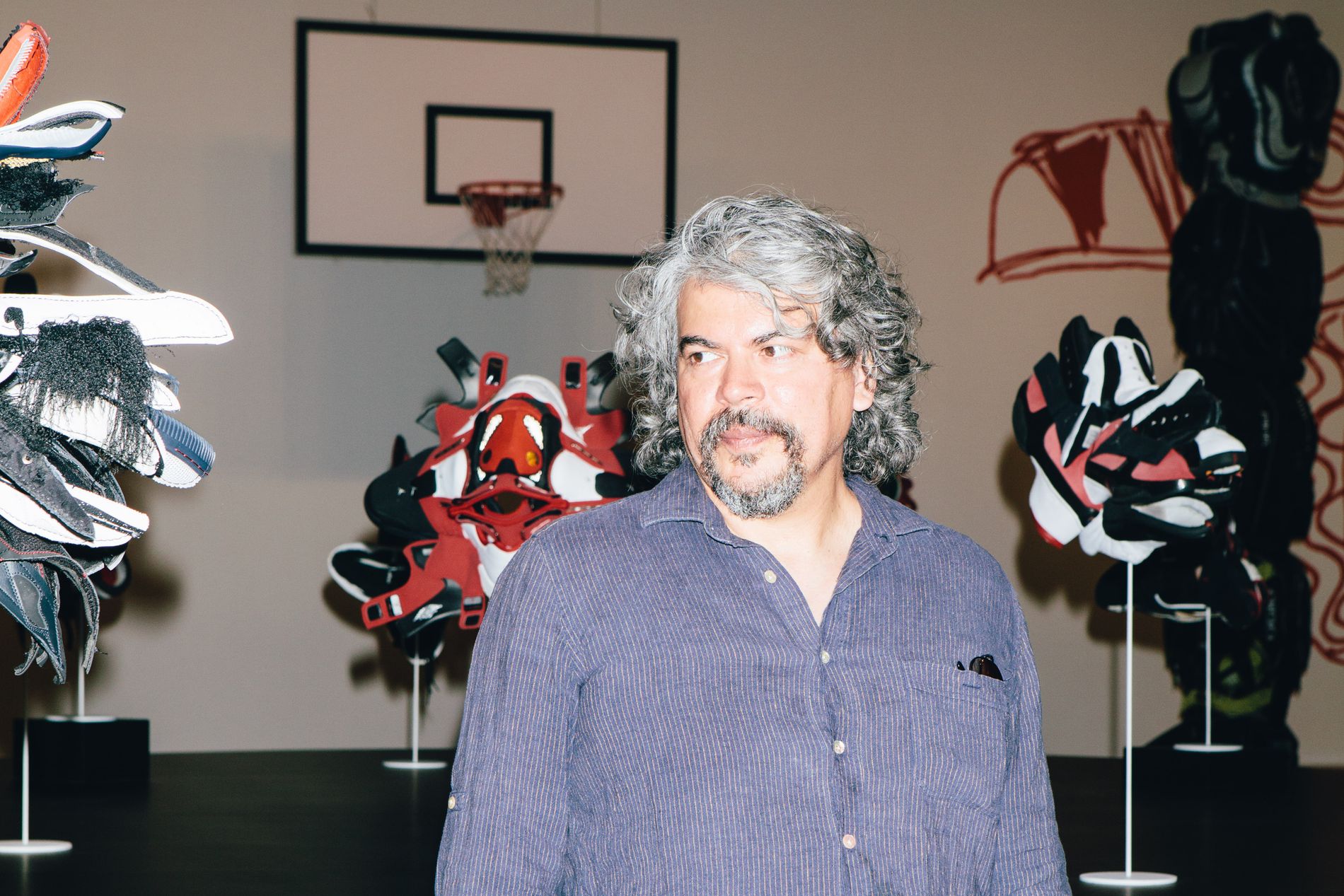
Jungen, who trained in Vancouver and apprenticed in New York, launched a career-making body of work in the late nineties when he began picking apart Nike Air Jordans and turning the red, white and black shoes into copies of traditional Northwest Coast masks. Prototype for New Understanding is a 23-part series of these soft sculptures created between 1998 and 2005, 20 of which are showing at the AGO. Then Jungen went on to make a cigar-store Indian from baseball gloves, stack golf bags into totems, weave blankets out of football and baseball jerseys and, more recently, fashion copies of Lakota horse masks from more brightly coloured Nike shoes.
Not content to simply mount a career survey, and emboldened by the size of the galleries they were filling in the AGO’s Zacks Pavilion, Jungen and contemporary curator Kitty Scott have installed all this sporting work in a mock basketball court, created with colourful lines painted on the black floor. Jungen calls this new installation Friendship Centre, which also gives the exhibition its title, a reference to the Indigenous community centres where everything from committee meetings to traditional dance takes place in the all-important gym.
So, at the AGO, you are invited into an Indigenous space to experience an art that is instantly effective: The wit in the incongruous merging of the brand-name running shoe and the museum mask, two high-value yet very different objects, is quickly grasped. And the craft is immediately visible and deeply impressive. Jungen, who returned to the Nike running shoe in 2015 after a decade’s hiatus, can now fluff out the laces to turn them into hair and transform their synthetic soles into feathers: Two war bonnets from 2017 feature great plumes of spliced shoes as Jungen rises to ever-greater virtuosity.
The works can initially read almost as one-liners: To anyone from Central Canada, his golf-bag totem poles feel like a particularly deft jab at the Oka crisis of 1990, triggered when the Quebec town tried to expand its golf course into a Mohawk burial ground. In fact, they were more broadly inspired by tensions over land use in B.C., where pristine suburban golf courses are often located on territory leased long-term from nearby Coast Salish communities. More aggressively than the humorous masks, the towering poles probe the contradictions between Indigenous and settler world views.
Stay with the work a while and it becomes clearer that Jungen’s negotiations between these extremes are manifold: His work compares the modern mass-produced consumer good with the historic hand-crafted art; it suggests layers of references to sporting competition as a replacement for actual battle, from the feathered war bonnets to white appropriation of Indigenous personas for athletes and teams. Yet the basketball court also offers a social salve for the communities that gather there. The coincidence that this show opened the same week Toronto celebrated the Raptors’ victory in the NBA championship with a massive public assembly makes the tensions in Jungen’s work all the more visible as it reflects on the particular transcendence that sport may offer its fans.