Casey Kaplan
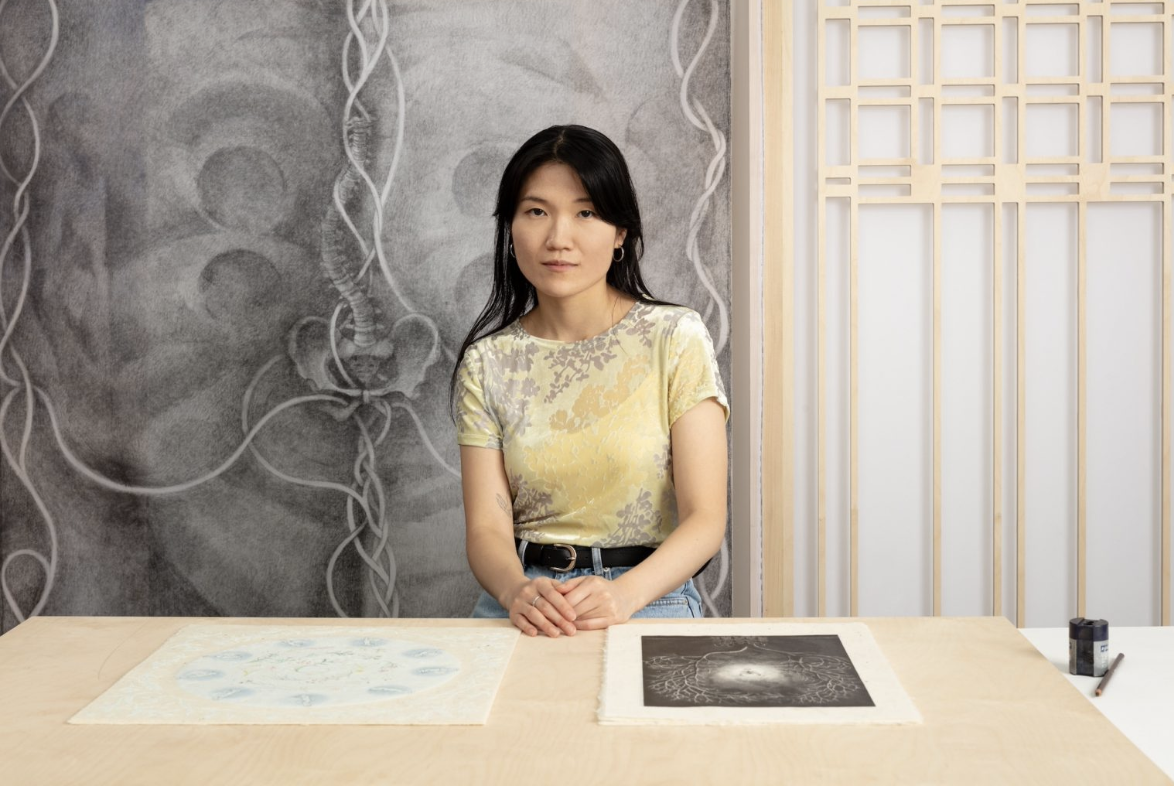
The Cinematic Origins of Cindy Ji Hye Kim’s Ghostly Paintings on Silk
The Korean-Canadian artist’s fascination with the unconscious shines through in her double-sided translucent silk paintings
By Stephanie Sporn | June 11, 2025
Films have played a pivotal role in helping Cindy Ji Hye Kim hone her fine art practice. “Learning about the Minimalist and Conceptual art movements was an eye-opening experience and made me question what it meant to make art,” the Korean-born, New York-based artist tells Artnet News of a Sol LeWitt documentary she watched as a RISD college student in the early 2010s. “I think that’s the moment when I became interested in ‘art,’ not as a final product of a series of techniques, but art as a rhetorical tool for questioning,” she said
In the same way, LeWitt’s abstractions reveal his preoccupation with the passage of time, Kim’s paintings feel highly introspective, conveying both her personal “sense of longing and loss” (largely stemming from her move to Canada at age 12) and curiosity surrounding unconsciousness and the afterlife. While the conceptual artist’s works are deceptively simple, Kim’s dreamlike and ghostly œuvre is outwardly complex in its narrative subject matter and ingenious, illusive technique utilizing the architecture of the painting’s stretcher.
Kim’s interest in the intangible and obscure is also rooted in film, specifically, Michael Haneke’s 2000 movie Code Unknown. “It left a huge impression on me as a twenty-something-year-old,” said Kim, who checked out as many books as she could on the Austrian director and screenwriter, known for his unsettling style and provocative critiques of society. Through her research, Kim discovered radical directors, such as Andrei Tarkovsky and Pier Paolo Pasolini, and similarly psychologically charged novelists, including Franz Kafka and Fyodor Dostoevsky.
These filmmakers and writers’ exploration of Sigmund Freud’s theory of the unconscious proved revelatory for Kim: “Beneath the conscious mask of a man, Freud saw a heartless ape, whereas [Carl] Jung saw a wounded angel. Whichever way you see the unconscious, there’s a tension between the bodily and the spiritual, and I find that to be a productive place for me to occupy as an artist.”
SCAD Museum of Art curator Ben Tollefson praises Kim’s “suggestive, dynamic, and ethereal” works: “She possesses an incredible ability to construct striking imagery that connects to the transcendent human experience, whether through our spiritual inclinations or our deeply seated psychological desires and fears.” As part of the Georgia institution’s deFINE ART 2024 exhibition series, which kicked off in February, Tollefson conceived Silhouettes in Lune, a site-responsive show by Kim. On view through July 29, the installation includes paintings and sculptures situated in an elongated gallery, around which Kim has drawn a mural.