Casey Kaplan

Brian Jungen
Brian Jungen Scores a Slam Dunk: The artist’s witty, immersive retrospective at the Art Gallery of Ontario broaches basketball, Indigenous culture and gay desire
July 19, 2019
By Charles Reeve
I’ve seen my share of the unexpected in art galleries – masses of dirt in Walter De Maria’s ‘New York Earth Room’ (1977); flights of human breast milk in Jess Dobkin’s ‘The Lactation Station Breast Milk Bar’ (2006–16) – but the locker rooms in Brian Jungen’s show ‘Friendship Centre’ still startled me. Comprising mirrors, lockers and benches nestled in alcoves between the galleries housing this mid-career survey, their subtlety made me wonder if I were seeing things. Were they for the security staff? Why not wall them off if the show needed the space?
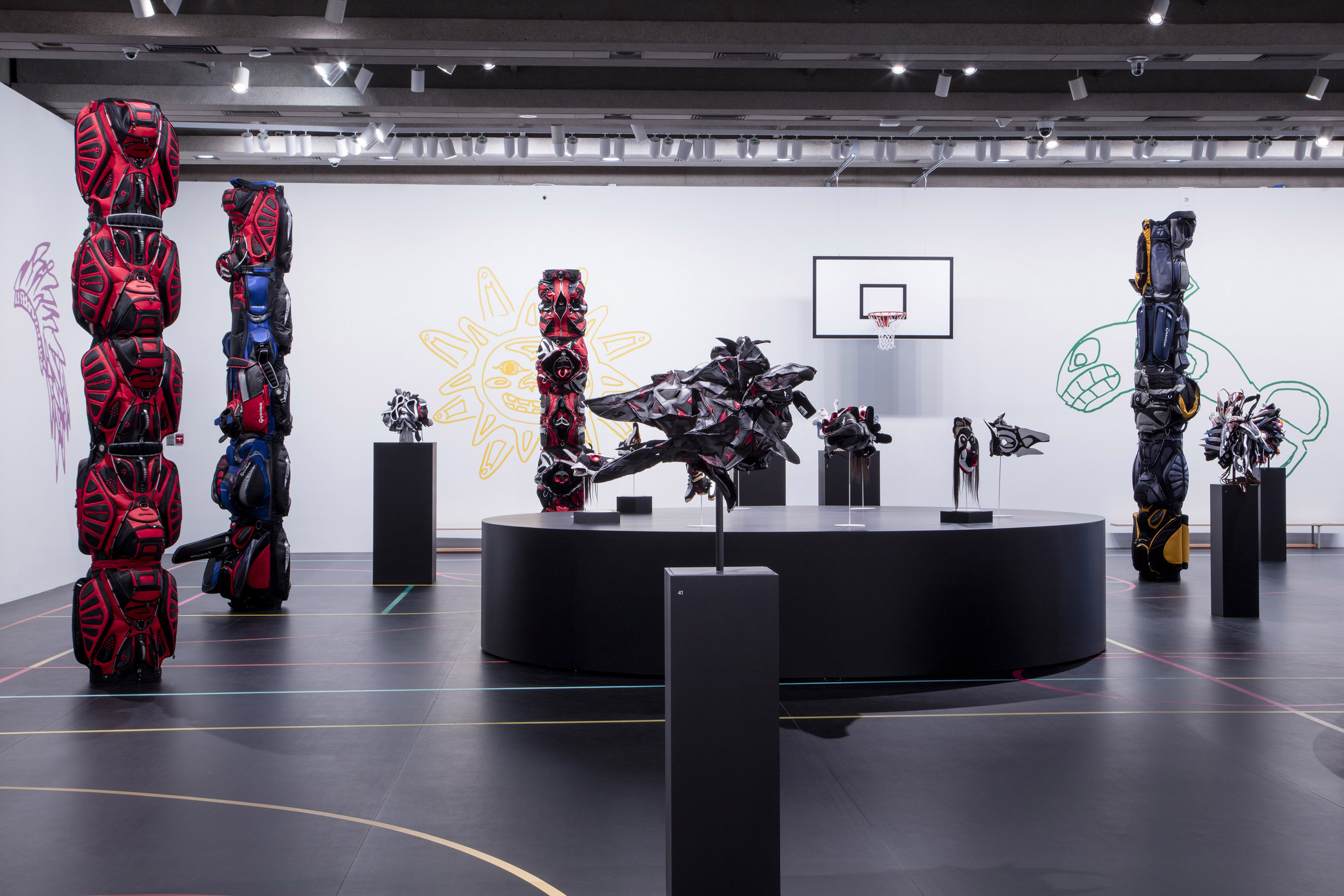
Then I got it: a classic Jungen touch, ambiguous, humorous, deftly transforming the materials at hand. Riffing on the galleries’ large, rectangular shapes, Jungen added free throw lines and hoops, installed the changing rooms and voilà: basketball courts, like those at schools, parish halls or friendship centres. A simple gesture, this transformation has far-reaching implications. In Canada, hundreds of ‘friendship centres’ support urban and rural Indigenous populations, providing social programmes and spaces for ceremonies, cultural activities and sport.
‘Modest Livelihood (Director’s Cut)’ (2019), a 46-minute, five-channel video Jungen made with artist Duane Linklater, follows both men hunting moose with Jungen’s uncle, Elder Jack Askoty, on the treaty lands of Jungen’s Dane-zaa community in Canada’s northwest. While often predictably – if engagingly – pastoral, ‘Modest Livelihood’ has its surprises. One is the inexplicable yet undeniable visual satisfaction that results when, having skinned and dressed their quarry, Jungen and Linklater matter-of-factly approach the hide, stretched out like a blanket, fold it, roll it up and slip it into a plastic bag as the film ends. There’s also the shocking image, during the hunt, when one of the men, rifle cocked, pauses by a small assembly of pipes and valves. Likely from the oil and gas industry that has ravaged indigenous lands, they serve as a grim reminder that even the most pristine wilderness is under a constant threat of despoliation.
Jungen’s many productively destabilizing gestures lend this show its power. His ‘Prototypes’, for instance, never resolve into either Pacific Coast Indigenous masks or repurposed Air Jordans. And while the title reclaims the AGO’s galleries for Indigenous – specifically Anishinaabe, Huron-Wendat, Neutral and Seneca – people, the show’s locker room reproduces a homoerotically charged space, with its post-practice towel snaps, and nods to the gay subcultures of public athletic facilities such as the YMCA. Identity, of course, is never so simple as ‘one or the other’, and the artist combines cultural signifiers often forced into mutual opposition together with witty resolve. Gay and straight, Indigenous and settler, mass-produced and hand-crafted: Jungen places these terms in close conversation with one another, the Haida carver in dialogue with the NBA all-star. The final report of Canada’s Truth and Reconciliation Commission was issued only four years ago; Jungen’s work is a radical first step towards justice.