Casey Kaplan
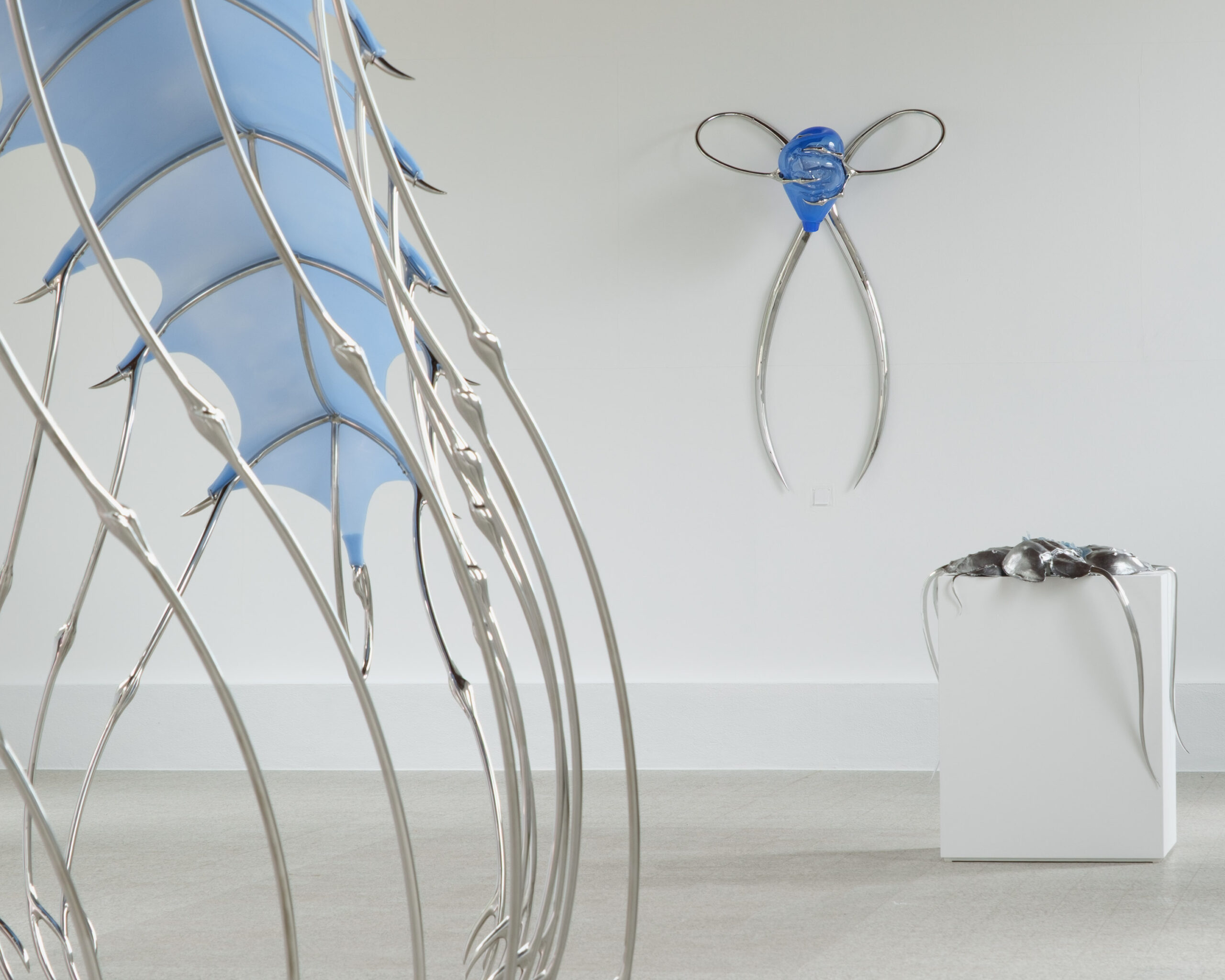
Museo Nivola presents Blue Blooded – Sangue blu, the first solo exhibition in Italy by Hannah Levy, opening Saturday, March 28, 2026 at 11:30 a.m. Curated by Giuliana Altea, Antonella Camarda, and Luca Cheri, the exhibition brings together a group of new sculptures inspired by the horseshoe crab, or limulus: an uncanny-looking marine arthropod that has survived for hundreds of millions of years and whose blue blood is now widely used to ensure the safety of vaccines and medical devices.
Levy’s sculptures combine polished metal with translucent silicone and glass, generating sinuous forms that – echoing a Surrealist-inflected imagery – recall animals, insects, and organic morphologies while subtly alluding to the elegance of Art Nouveau and Modernist design. Positioning herself within a lineage that includes artists such as Meret Oppenheim, Louise Bourgeois, and Robert Gober, Levy merges industrial aesthetics and natural imagery to evoke presences that are both seductive and unsettling.
The central work of the exhibition is a large tentacular structure in stainless steel and silicone. It resembles a light canopy supported by long, slender legs. Its proportions echo those of the museum space and its silhouette suggests at once a beach shelter and a fossilized skeleton on display in a natural history museum. The stretched spiny shell-like covering and legs inspired by the morphology of the horseshoe crab create an architectural organism that inhabits the nave like a presence suspended between refuge and relic.
Alongside this installation, are a series of glass sculptures supported by sharp metallic claws. These creature-like forms appear as bodies in tension, caught midway between fluid and solid states. A glass shell-like form stretches across delicate supports, like an animal acclimatising while finding refuge in a new dwelling. The glass in these works exists as a record of past action, the moment of its molten transformation under the pressure of stainless steel, frozen in time.
For more information, please visit Museo Nivola’s website.